Showing posts with label Computer Science. Show all posts

Wednesday, June 24, 2020

Flattening the Curve: Teaching During the COVID-19 Pandemic

Ten weeks, that is how long online remote teaching lasted and the ups and downs of social distancing were a constant pull on my emotions. I never thought in a million years that I would live through and work during a global pandemic.

March 13th, 2020 we received an all staff e-mail, that stated the Governor had closed all schools until March 30th. We all walked out of our building unsure of our next steps, when we would ever see our students again and with no clue how we would teach our students. The college I adjunct at also had decided after the Spring Break, to go online with all courses as well. Between TikTok, Tiger King,  Video Games, Cleaning, and Legos, at first helped me keep my sanity.

March 25th, two weeks later we were informed we would start online distance learning with our students.

The process to start online remote-learning during the social distancing lock down was not easy.  It was bumpy, filled with frustration at a slow approach to disseminate information. The district was deliberate in only giving information when they finalized it and gained our state's backing for the plans. Then after two weeks of the administration planning, it was our turn. We were given training on how to use our school's selected means of educating students. Then we were asked to create modules for our common courses and share them with staff who teach the same courses. Students began logging in a week later, and we were on week four of lock down when all students were instructed to login. Our district worked with teachers and the Local Intermediate Unit (a state-affiliated education specialist facility in PA) to use Odyesseyware and run courses for our senior students.

I was allowed into my classroom March 28th to pick-up any supplies I needed to help with online teaching. It was very surreal walking in and only having a few moments to gather the things I thought I would need.


@a4jsk Missing my students!! ##gibsongeometry ##teachersbelike ##teachersoftiktok ##fyp ##foryoupage
♬ Robin Williams Edit - twelveshade

The following week we would start to go live in our online platform for students. I made sure all students were enrolled in one of my Google Classroom Courses. A great positive, all but 2 students responded to my course enrollment requests! I then used my Google Classroom Streams as a way to push out announcements, I sent memes to help add a little humor to the days. 

April 1st students saw an important link that said, "Urgent Update" which led to this YouTube Video: News Alert - Breaking News, yes I Rick Rolled my classes.

At home when classes started, my wife, a 1st-grade teacher in a neighboring district, was already working on online instruction and with her students. My daughter, a 1st-grade student, was also working with her teacher daily online. I was left with the toddler, to keep her entertained and out of the way while my wife taught her students and guided our daughter in the asynchronous work she was assigned. This was very difficult at times when I had morning faculty and PLC Zoom meetings myself. We made it work while working from home we navigated our way through teaching students.
My Best Covid-19 Looks & Memes!

The rest of the days became a blur. One morning I found dirt tossed into my coffee, the start of a really bad day. There were terrible meetings, information that was ineffective, and the thought of not seeing students ever again. Then another day a squirrel busted in through the unused chimney flue that is in a room we have dubbed the "Sun Room". Causing a full ruckus to our morning routine, he came back a few weeks later as well, disrupting the new normal. 

All students did not work, and the AP Classes that I teach had all of the seniors removed to the LIU course, and then halfway through the Marking Period given back to me to hurriedly prepare for an exam that they had missed too much content for. All of my AP Computer Science A students took their exams with no problems, but my AP Computer Science Principles only had 9 of the 24 students prepare all of their AP CSP Performance Task Projects. This was a major let down, and one that had me questioning how to feel. Do I go with the school's mantra of "Grace over Grades" or make sure to uphold the expectations and rigor of an AP course. I felt very torn over this issue... It did not help that the students were not added into my own AP Course until part way through the marking period. 

Teaching in a college course online was not as difficult. I only had issues with attendance while trying to have open Zoom Meetings for my 5 freshmen and 1 Junior. Usually it was just me and my Junior, chatting about the weeks events and then leaving to check out the newly arriving finished assignments. Our Distributed Leadership Team began meeting virtually and had several meetings with themes to lighten the mood as well!
DL Zoom Hat Day
DL Zoom Hat Day
DL Zoom Dress to Impress


While there was a feeling of having so many drawbacks, there were also many great moments as well! My wife while working with her students was able to reach and help one of her most in-need students. My daughter increased her reading fluency, and our toddler has been progressing with her vocabulary as well as her ability to interact with the family in very positive and mannerly ways. I had a zoom paint night with students in the YCCOSP Program, a very fun evening! Students who were very successful finished my online courses early, and some who did not fare as well on the unit pretest, that wanted to do better, actually reached out for help. I did so by giving new assignments and additional options for finishing out the year with a stronger grade.

The most exciting thing to happen in all of this was for my proposal to have a Game Design Academy was picked up by our curriculum director. I am now starting to create my own 1 credit Game Design Course, a part of the full 3 credit idea I promoted, but one that I am super excited to fully develop to help students learn in exciting new ways. At the college I adjunct for, I used my love of technology to facilitate a discussion on Social Media and Wellness. I also kept up with my online learning and started to do learn more about Distance Learning from educational companies like Nearpod, Flocabulary, and Flipgrid. I tried to incorporate a little bit of each in my teaching. I tried to push myself and build my own abilities in technology while at home teaching. 

May 29th all grades were due. In the end it was very anti-climactic. There were no hugs good-bye or great hilarious moments in the classroom that I usually have my final days of the school year. My students did not get a Prom, they did not have a formal Graduation. We missed out on a lot of time together, and great projects that I have developed over the years. All because of a microscopic threat, one that cannot be fully understood yet. 
June 4th I watched The William Penn Class of 2020 Graduation from the online streaming video produced for our students, parents, staff, and community. It was a surreal event, full of real emotions, highs, and lows, and the events that occurred can never be forgotten!


Saturday, February 29, 2020

2020 #PaSTEMambassador

This week started off with the flu hitting home.  My wife and daughter both fell ill and missed school for several days, I was very cautious in helping them with their sickness and thankfully I did not catch the stomach bug they had.

My Acceptance E-Mail into the 2020 PA STEM Ambassador Program

This was great news because for the final two days of February I was at training because I was selected as a 2020 PA STEM Ambassador through the Pennsylvania Statewide Afterschool Youth Development Network (PSAYDN).  I was chosen as 1 of 28 educators and business leaders to work with PSAYDN to develop our advocacy efficacy and work with policymakers in The Commonwealth of Pennsylvania.
The Stats of this Amazing Cohort!

For two days we listened and learned about great organizations such as The Education Policy and Leadership Center (EPLC), the STEM Education Coalition, the Afterschool Alliance, the PA Department of Education STEM Initiative, and the PA Workforce Development Board.  All of these advocacy groups had great information and a powerful message to engage students in STEM activities, during and after school.  One of the best nuggets of information was from the Keynote Speaker was that STEM is not just content, it is an inquiry-based take on processing and learning.


With coming on board for this program I met some great innovative educators and business leaders.  We are all being tasked with creating a policy project for the next 10 months, and with my passion for computer science and gaming, I think this is a great way to help push game design and video games are legitimate STEM learning opportunities.  I hope that this will also have a greater impact on urban student experiences.  To find out more about the features of the program check out the press release: 2020 STEM Ambassadors!

Saturday, July 13, 2019

ESL Blog #6 - #CSForAllPA

For the 2019-2020 school year, I am planning on teaching the AP Computer Science Principles and AP Computer Science-A courses.  The courses are not only a recommendation from the Commonwealth of Pennsylvania, and the Department of Education, but also another step in the direction of equity for students in our diverse population.  With computer science coming into its second year at William Penn SHS, I am committed to making sure all students are represented from all backgrounds.  That being said, I also have to be very strategic in how I am making these curriculum's available to students in our district.


CS Programs for EL Students

At the University of Texas in El Paso, Tech-E classes, seminars, and summer programs have been created to increase migrant student exploration in computer science.  The article I found in my Google Alerts talked about the start of this program in 2015, where it was just a small summer week-long camp, and that it has grown to full-semester courses offered yearly to undergraduates at UTEP.  The program is very strategic in offering experiences to students who are in transient worker families and exposes them to computer science and engineering.  This program is something that I think could be modeled at the high school level, and be used to get students interested in CS at the elementary and middle school levels.

CS Tools that could be used to inspire the next generation.
Raspberry Pi, Micro Bits & Video Games!

A pair of professors at Northwestern are also trying to make computer science more inclusive.  Sara Hood and Ian Horswill are looking to expand computer science offered to EL students, women and African Americans.  They are working to make sure all student have a safe space to practice computer science and realize that failure is just a stepping stone when creating computer programming.  The two are also making sure that students in the CS111 introductory course are coding for a purpose, to make something personal and worthwhile.  Giving students personal connections to a course make it more meaningful, and something that I can do with my CS students and the projects they are going to be creating.

The Push for CS in PA

Some very alarming statistics came out of Pennsylvania in the 2017-2018 data for students.  Out of 4,010 students that took the AP CS exams, only 309 were from minorities including EL Students.  Many students do not take the opportunity to try CS and luckily Governor Tom Wolf has already spent $40 Million on computer science grants for students and apprenticeships.  All of these initiatives are starting to be pushed in PA for the 2019-2020 school year, and I feel so glad to be a part of the Computer Science For All drive.  I am more proud that I began the program at our school a year before the state push.  Now I need to challenge more of our EL students to try Computer Science.

PA CS Statistics from the #CSForAllPA Summit


Saturday, June 29, 2019

Blog #4 ESL 509 - Learning English through Gaming

This past week I had the pleasure to attend the PaTTAN conference, #CSForAllPA.  Throughout the two days of keynotes and workshops, I attended some on building diversity in the computer science classroom.  I recently started teaching AP Computer Science Principles this past year and had a few students who were not native English speakers.  One such student came from Puerto Rico, and although he had an excellent education including English, speaking the language was not a fully acquired skill.  At the beginning of the year even with his limited English, he and I did bond over our shared interest in computers and video games.  This got me thinking about the wide range of "gamers" that are in our world.  During the workshops, one that I attended was called, "Supporting Diversity, Equity, and Inclusion through Esports."  The presenter had some interesting data and a great anecdote that described one English Learner's journey to learning English by becoming engaged in Esports at his high school.  He developed a sense of belonging and had a personal reason for learning English when he became a member of their team, playing video games.

Video Game Club

For the past 12 years of advising students participating in William Penn's Video Game Club, that I and a few other teachers have run, I have bonded with more students who had this common interest with me and have met a lot of great students who I would not have had in class.  One young man, LaQuinn Thompson, has taken this passion and is helping it drive him to create an esports team within York City itself, with his BEAST Initiative Push.   He describes video games as the way he and his family bonded when he was younger and hopes to help other young people bond with gaming.  The Esports phenomenon has been growing very steady, and the US has a lot of catching up to do with the rest of the world in this venue, but our very own Harrisburg University team, The Storm, has brought some regional publicity.  They won the Collegiate Esports Championship in Overwatch this past spring on ESPN

William Penn Video Game Club

From the Esports workshop I attended, I hope to also bring more of a competitive nature to our weekly Video Game Club meetings, and help establish an Esports team to compete and bond students.  The North American Scholastic Esports Federation, helps bring teens and curriculum to High Schools with esports.  There are designated roles and beyond the gaming challenges that can bring multiple youths together to create a mindset of community and establish a guide of career paths for their future.  My hope is that we diversify and have some English Language Learners who want to join and enhance their educational career at William Penn through Esports.  


Video Games for the English Language

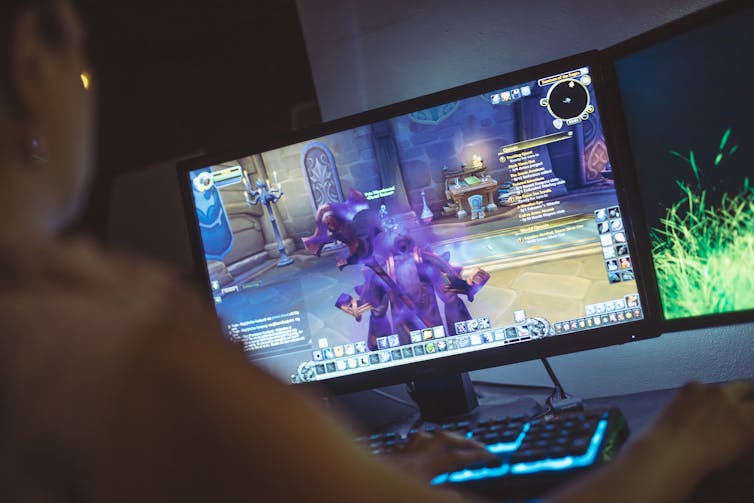
In a recent article on, The Conversation, the question was asked, "Can You Learn a Language Playing Video Games?", and the author looked at several Massive Multiplayer Online (MMO) video games and described how players, both young and old, had to communicate in real-time with little time to be self-conscious of how the language was spoken, meaning the player was more likely to just communicate freely and not worry if they were muddling their language.  This freedom is likely to build student self-esteem and the use of another language.  The high levels of extrinsic motivation to level up a character or find rare equipment for the character, make a player strive to work well with others to do obtain these in-game rewards.  


Another blog, 3 Reasons Playing Video Games Helps You Learn English Faster, described the process similarly and said games helped alleviate stress in learning.  They also help develop cognitive skills, linguistic skills and provide in-game context to learning.  While playing a video game, a developer often makes the player start small and learn all of the mechanics of how a character can move, advance their effectiveness in the game and use their environment.  All of the learning is scaffolded to help the player achieve a better in-game character while also learning about their in-game surroundings.  The levels grow progressively harder to pass, and in-game puzzles or riddles help challenge the player in learning the environment or obtaining their next goal.  Learning happens all through video games and creates a safe place for a student to fail and try again to pass to the next level.  English is used in most games, and reading and responding to the passage in context to move to another level is a must for any player and would aid English acquisition by an EL student.  Players also can play collaboratively giving them time to practice their speaking and listening skills in English.  

Some downfalls to gaming would be that not all games are designed to provide the basics of grammar or vocabulary, and the structure is not progressive.  Meaning, the grammar, and vocabulary are not taught in a way that would build upon itself, and would not be used to help students decipher the building blocks of the sentence and decipher a verb or noun in the context.  This is where the teacher would have to step, and scaffold to help English Language Learners with some mini-lessons on the vocabulary, or take a break and help students break down a sentence to identify its structure.  Then return to the game for more fun and learning. 

Through Esports and Video Games, students can learn English, find career paths, develop a sense of community, build trust in learning even at the expense of failure, and all in the safety of a controlled environment.  This week has me thinking a lot about how to use these tools with English Language Learners and students of all backgrounds in my school.  It is my hope to push the boundaries of my student's education and help them find common ground in the games they enjoy.