Showing posts with label eSports. Show all posts

Tuesday, June 17, 2025

AI Supports Esports in Education

As an avid tech nerd, gaming enthusiast, and digital native, I have always been one to test new technologies, push the boundaries, and make sure students can see the uses of technology in their everyday lives. I used ChatGPT when it was first showcased, and had it create a list of reasons why scholastic esports were important to use in school. Gaming, computer science, and AI all blend nicely together in the world of education. Then, a few years later, I found that same prompt and prompted ChatGPT to update my prior request. It gave me two different options this time, and in much more of my own voice. Below are the two different prompts. Let me know in my social media polls which one works best!

Image of the Author as an action figure, holding steam deck with additional esports tools, titled Esports Educator. Made with Chat GPT's image creation tools. a

Response 1: 

Why Esports Belongs in High Schools: An Instructional and Engagement Powerhouse

After nearly two decades in education—spanning classroom teaching, instructional leadership, and higher education support—I’ve seen firsthand the transformative power of student engagement. One of the most impactful and often overlooked tools to reach today’s learners is esports. Whether students are competing at a high level or casually connecting in a club environment, esports offers high schools a dynamic platform for instruction, inclusion, and innovation.

A New Pathway for Engagement

Not every student connects with traditional extracurriculars. Esports offers a new, highly relevant option—one that speaks their language. As someone who’s built both a computer science pathway and a scholastic esports program from the ground up, I’ve seen students who struggled to find their place suddenly light up when handed a controller or asked to lead a strategy session.

Esports clubs provide an entry point that feels familiar and exciting. Students engage not only in gaming but also in teamwork, leadership, and communication. I’ve coached students who started off shy or academically disengaged and watched them grow into confident leaders, shoutcasters, analysts, and even aspiring coders.

Inclusive by Design

Unlike traditional sports, esports is inherently inclusive. It doesn’t discriminate by physical ability, gender identity, or socioeconomic background. I’ve seen students who might otherwise be sidelined become integral members of a thriving community. In our club spaces, students with IEPs, English language learners, and those from diverse backgrounds came together over shared goals and mutual respect.

Casual players are just as important as competitive ones. Whether they're helping moderate a Discord server, creating team logos, managing social media, or simply enjoying the community, there’s a role for every student.

Real-World Skills in Action

In my time as a NASEF Fellow, Mentor, and now Community Leader, I’ve helped other educators tap into the full educational potential of esports. When structured intentionally, these programs teach far more than gameplay. Students learn:

  • Communication and Collaboration – Every match is a team effort. Students learn to give and receive feedback, resolve conflicts, and adapt strategies in real time.

  • Digital Literacy and Tech Fluency – From streaming and shoutcasting to hardware troubleshooting and software configuration, esports cultivates essential 21st-century skills.

  • Critical Thinking and Decision-Making – Strategy, adaptability, and analysis are core to gameplay—and all transferable to STEM fields and beyond.

And let’s be clear: esports isn’t “just gaming.” It’s broadcasting. It’s event planning. It’s graphic design. It’s business. It’s coding. In my time as Director of Secondary Services at Harrisburg University, I worked to align dual enrollment and workforce development programs with the kinds of real-world skills esports fosters. The career connections are already there—we just need to build the bridges.

A Culture of Belonging and Well-being

There’s also a social-emotional side to this work. Esports clubs give students a safe, welcoming space to be themselves. They form friendships, build community, and find a sense of purpose. During some of the most isolating moments of the pandemic, our esports program became a lifeline—students kept showing up not just for the games, but for each other.

Looking Forward

High schools should embrace esports not as an afterthought, but as a cornerstone of modern student engagement. When structured thoughtfully, these programs blend learning, community, and fun in ways that are hard to replicate elsewhere.

Whether you’re running a varsity program or just starting a casual club, esports is more than just an extracurricular—it's a future-ready, student-centered instructional tool. And it works.

Tuesday, June 15, 2021

Finding Inspiration in the Gaming Industry

Reasoning

Ever wonder what's out there in the gaming industry? What about esports? Where are the people who look like you? How many women or BIPOC or LGBTQ+ people are represented in the industry? If you look you may see, much like other white-collar professions in the U.S., the industry of video games is dominated by white men, but they aren't the only ones playing games! Demographics for gamers are much more diverse than the professionals who are making the games. So where do we look for diverse student inspiration?


In the book, The Esports Education Playbook: Empowering Every Learner Through Inclusive Gaming, Bradford Harris, a NASEF Fellow, is quoted as saying, "I am really big on making sure I expose as many Black and brown children to esports as possible because it's not being seen. That's the reason I jumped into it (esports in education). So every time I go somewhere, I start asking those hard questions." 

The demographics of the esports and gaming realm are not what I see on a day-to-day basis as an educator. I see many BIPOC students and want them to see themselves in a growing future with technology. So I had to go searching and find inspiration, representation, and career options for the gaming industry.

How can this help others?

Educators have to dig, sift, and vet content with BIPOC, female and LGBTQ+ representation. Here is what I have used as career exploration tools, that help showcase their students represented in the medium. Many of the videos I found were accompanied by a Google Form or a Google Doc as a journal, to reflect on the learning and opportunities in the gaming industry. 

With 53% of my high school population in the Latinx demographics, I really wanted to help my students learn about the industry and where they can find room for themselves. Use the following links to help showcase panels and people in the Latinx community working in games:

Latinx in Gaming GDC 2018

Learn more about the panels’ work!
Edgar Serrano: Lienzo Studios
Daniel Monastero: Garage 227 Studios
Andro Miralrio: Keywords Studios
Gracie Arena Strittmatter: EA Gracie Intro

In the Know: Latinas in Gaming

Our African American population is 35% and they deserve to see themselves represented as well. Find BIPOC representation with these links:

1st Black Owner of Game Development Company

Gaming for Everyone: Blacks in Gaming GDC Feature

Other demographics are important too! Asian representation in gaming links:

NASEF: Careers in Esports - Team Manager, Andrew Kim

Where are the women? The number of girls in any program is much lower than some demographics, and they deserve a spot at the PC. Not just as support either! Women in gaming links: (Also look at the Latinx community!)

Esports Explore - Esports Journalist Women in Gaming

Gaming can make a better world | Jane McGonigal

Studying Esports in the UK

Some great interviews for more learning. We need to inspire, and share stories and successes of those who came before: 

Esports Explore - Content Creators

Esports Explore - Game Designer


BIPOC Entrepreneurs   

While driving, I listened to some podcasts and found The Toys & Tech of the Trade Episode 35, which highlighted an interview with Sebastian "Chosen1" Burton. The interview led to an interesting conversation with Sebastian about his work in esports since the age of 19. I was enthralled by his story and reached out to him after looking up his esports company, Gold Standard Gaming. Through a lot of conversations with my principal, I finally got Sebastian to Zoom into our school and speak to students in the Cybercats and my Exploration of Game Design courses. Finding BIPOC Entrepreneurs was a dream come true, and having students chat with Sebastian was an amazing experience. Mr. Burton spoke about his experiences in the industry, gave some life lessons in perseverance, and then discussed actionable steps students could take today to leverage their social media and graphic design skills to help launch a career in anything!


Final Thoughts

Finding inspiration and diversity in the gaming field can be daunting, and searching through hours of footage is a must if you want your students to feel represented. I know I am lacking in some demographics, as I only have one video showcasing a member of the LGBTQ+ community, and I welcome any advice in the comments. My students, our students, deserve to see themselves in the game industry!

Saturday, June 29, 2019

Blog #4 ESL 509 - Learning English through Gaming

This past week I had the pleasure to attend the PaTTAN conference, #CSForAllPA.  Throughout the two days of keynotes and workshops, I attended some on building diversity in the computer science classroom.  I recently started teaching AP Computer Science Principles this past year and had a few students who were not native English speakers.  One such student came from Puerto Rico, and although he had an excellent education including English, speaking the language was not a fully acquired skill.  At the beginning of the year even with his limited English, he and I did bond over our shared interest in computers and video games.  This got me thinking about the wide range of "gamers" that are in our world.  During the workshops, one that I attended was called, "Supporting Diversity, Equity, and Inclusion through Esports."  The presenter had some interesting data and a great anecdote that described one English Learner's journey to learning English by becoming engaged in Esports at his high school.  He developed a sense of belonging and had a personal reason for learning English when he became a member of their team, playing video games.

Video Game Club

For the past 12 years of advising students participating in William Penn's Video Game Club, that I and a few other teachers have run, I have bonded with more students who had this common interest with me and have met a lot of great students who I would not have had in class.  One young man, LaQuinn Thompson, has taken this passion and is helping it drive him to create an esports team within York City itself, with his BEAST Initiative Push.   He describes video games as the way he and his family bonded when he was younger and hopes to help other young people bond with gaming.  The Esports phenomenon has been growing very steady, and the US has a lot of catching up to do with the rest of the world in this venue, but our very own Harrisburg University team, The Storm, has brought some regional publicity.  They won the Collegiate Esports Championship in Overwatch this past spring on ESPN. 

William Penn Video Game Club

From the Esports workshop I attended, I hope to also bring more of a competitive nature to our weekly Video Game Club meetings, and help establish an Esports team to compete and bond students.  The North American Scholastic Esports Federation, helps bring teens and curriculum to High Schools with esports.  There are designated roles and beyond the gaming challenges that can bring multiple youths together to create a mindset of community and establish a guide of career paths for their future.  My hope is that we diversify and have some English Language Learners who want to join and enhance their educational career at William Penn through Esports.  


Video Games for the English Language

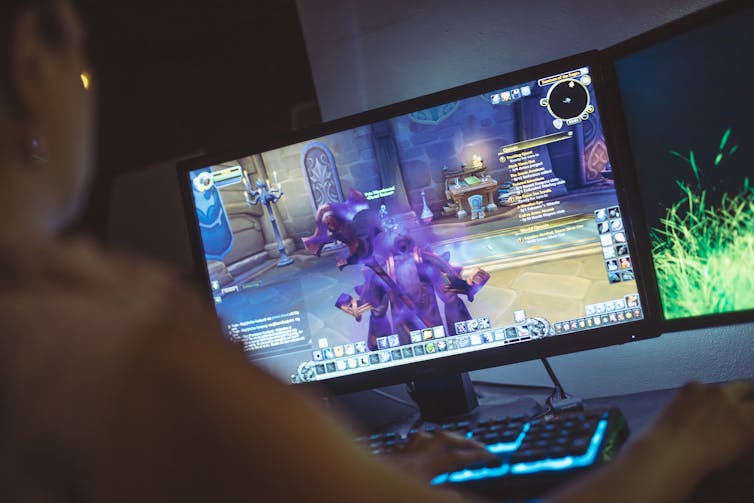
In a recent article on, The Conversation, the question was asked, "Can You Learn a Language Playing Video Games?", and the author looked at several Massive Multiplayer Online (MMO) video games and described how players, both young and old, had to communicate in real-time with little time to be self-conscious of how the language was spoken, meaning the player was more likely to just communicate freely and not worry if they were muddling their language.  This freedom is likely to build student self-esteem and the use of another language.  The high levels of extrinsic motivation to level up a character or find rare equipment for the character, make a player strive to work well with others to do obtain these in-game rewards.  


Another blog, 3 Reasons Playing Video Games Helps You Learn English Faster, described the process similarly and said games helped alleviate stress in learning.  They also help develop cognitive skills, linguistic skills and provide in-game context to learning.  While playing a video game, a developer often makes the player start small and learn all of the mechanics of how a character can move, advance their effectiveness in the game and use their environment.  All of the learning is scaffolded to help the player achieve a better in-game character while also learning about their in-game surroundings.  The levels grow progressively harder to pass, and in-game puzzles or riddles help challenge the player in learning the environment or obtaining their next goal.  Learning happens all through video games and creates a safe place for a student to fail and try again to pass to the next level.  English is used in most games, and reading and responding to the passage in context to move to another level is a must for any player and would aid English acquisition by an EL student.  Players also can play collaboratively giving them time to practice their speaking and listening skills in English.  

Some downfalls to gaming would be that not all games are designed to provide the basics of grammar or vocabulary, and the structure is not progressive.  Meaning, the grammar, and vocabulary are not taught in a way that would build upon itself, and would not be used to help students decipher the building blocks of the sentence and decipher a verb or noun in the context.  This is where the teacher would have to step, and scaffold to help English Language Learners with some mini-lessons on the vocabulary, or take a break and help students break down a sentence to identify its structure.  Then return to the game for more fun and learning. 

Through Esports and Video Games, students can learn English, find career paths, develop a sense of community, build trust in learning even at the expense of failure, and all in the safety of a controlled environment.  This week has me thinking a lot about how to use these tools with English Language Learners and students of all backgrounds in my school.  It is my hope to push the boundaries of my student's education and help them find common ground in the games they enjoy.